

With the help of investors, retail partners, consumers and other believers, Melt Organic is challenging major food brands in the red-hot category of organic foods
Melt looks like butter. Spreads like butter. And in most ways, tastes like butter. But of course — it’s not butter.In fact, the only reason Melt exists is because the company’s founder, Cygnia Rapp, couldn’t eat butter (or many other common fat sources) without becoming ill.

“She was 30 years old at the time and decided she didn’t want to live that way,” explains Meg Carlson, an experienced food industry veteran and the company’s president and CEO. Cygnia’s solution? Develop a not-so-easy-to-follow recipe for an alternative to butter.
The recipe looked something like this:
Step 1: Invent a butter substitute made of healthy fats, most notably virgin coconut and flaxseed oil.
Step 2: Partner with the University of Idaho Food Technology Center to commercialize the product — and then recruit local investors to finance the company’s growth plans.
Step 3: Go head-to-head with some of the country's largest food companies in one of the most competitive product categories and one of the most cutthroat industries: consumer packaged goods.
A first-time entrepreneur, Cygnia did not underestimate the challenge she was taking on. But, she says, the complexity and hurdles of bringing a good idea to market still came as a surprise.
“Thinking about the idea, you go from A to Z and you don’t think about all the dots you have to connect in between,” she explains. “In your mind, you’re seeing how it all comes together in a perfect world without realizing how inefficient the industry is.”
Recognizing the obstacles, Cygnia approached the Boise Angel Alliance — a network of high net worth individuals who invest in early-stage companies — for the money and expertise to help overcome them.
That’s where she first met Meg, a member of the alliance who was using her decades of experience in multinational food companies to vet the deal for the investors.
“Entrepreneurs will come in and basically say ‘Tell me if my baby’s pretty,’” Meg says. “At that early stage it can be difficult to tell.”
Still, Meg liked what she saw with Cygnia. So much so that — in addition to recommending the Boise Angel Alliance investors — Meg, and her business partner Korri Hall, began consulting with Cygnia in exchange for stock.
“The product was good. It had won Best of Show at Natural Products Expo West. But she needed a brand, a place to make the product, marketing and distribution,” Meg says.
“I put her in touch with a couple of really smart people who used to work for me. I could be an advisor, but not hands on.”
With initial outside funding of about $200,000 from a few angels, including Meg and Korri, Cygnia began to build. With guidance from Meg, Cygnia and her consultants recognized a strong brand name could help the company attract consumers and enter the broader market.
They began researching their options and finally settled on a name they thought had all the characteristics they were looking for. One problem though: it was already owned by a large food company. While this large company hadn’t used the trademark, Cygnia and Meg decided it was best not to tip their hand and express interest in it for fear the company would decide to re-register it or begin putting the trademark to work.
Instead, Cygnia and Meg decided to wait for the trademark to expire, hoping the large corporate bureaucracy had lost track of this particular asset and their nimble little startup could jump on it.
Their bet paid off. In the wee hours of the morning on the day the trademark expired, Meg and Cygnia were able to grab it. And with that, Melt was born.
“It’s a great name,” Meg says. “It describes the benefits of the product. We’re not fashion, but what we choose to eat and drink says a lot about who we are.”
With a new name and an industry-first, sustainable square package, the company doubled-down on growth, expanding distribution to about 250 retailers, mostly in the West. Additional opportunities came, including a possible deal with a national retailer that would’ve expanded Melt to over 1,000 stores.
“The question became ‘How do we go from a solo founder entrepreneur with a few consultants to being a company that supports that kind of business opportunity?’”
Meg and Cygnia took the challenge to their investors, explaining that they believed it was time to bring in additional capital and an experienced management team to oversee the company’s growth.
The investors, including the Boise Angel Alliance and several other angel groups, agreed. They suggested Meg take the reins.
And Meg, as excited as ever for the possibilities for the company, came on board as Melt’s CEO.
Note: S.W.O.T. stands for Strengths, Weaknesses, Opportunities and Threats. It's a planning technique to understand the viability and strategy of a business.
“We got strategic,” Meg says. “We determined our vision, mission, and values. We did a S.W.O.T. analysis. We determined what our strategic priorities were and we got to work executing.”
Among other things, this meant a major brand overhaul and flavors.
“The first test of survival was overhauling the brand, the packaging and the formulation, and investment in digital marketing.”
Melt got a new look and began rolling out nationally — an effort that required cash for promotions, sampling and slotting fees, a type of “rent” some retailers charge for shelf space. All while trying to make a product that was notably better than anything that existed in the marketplace.
“We were competing with big guys,” Meg says.
“You basically zag when they zig. You continue to raise the bar. They can outspend you every day of the week. We have to be smarter, more nimble and more creative. Most importantly, our products have to be amazing.”
For as much focus as the Melt team gave product development, they never lost sight of the importance of a personal relationship with their consumers. They listened closely to feedback. They reached out with recipe and healthy lifestyle ideas. And they even made an effort to support causes their customers supported. Anything they could do to stand out against their much larger, well-funded competitors.
“When you’re a startup or seed stage company, all the momentum tries to push you into the grave,” Cygnia says.
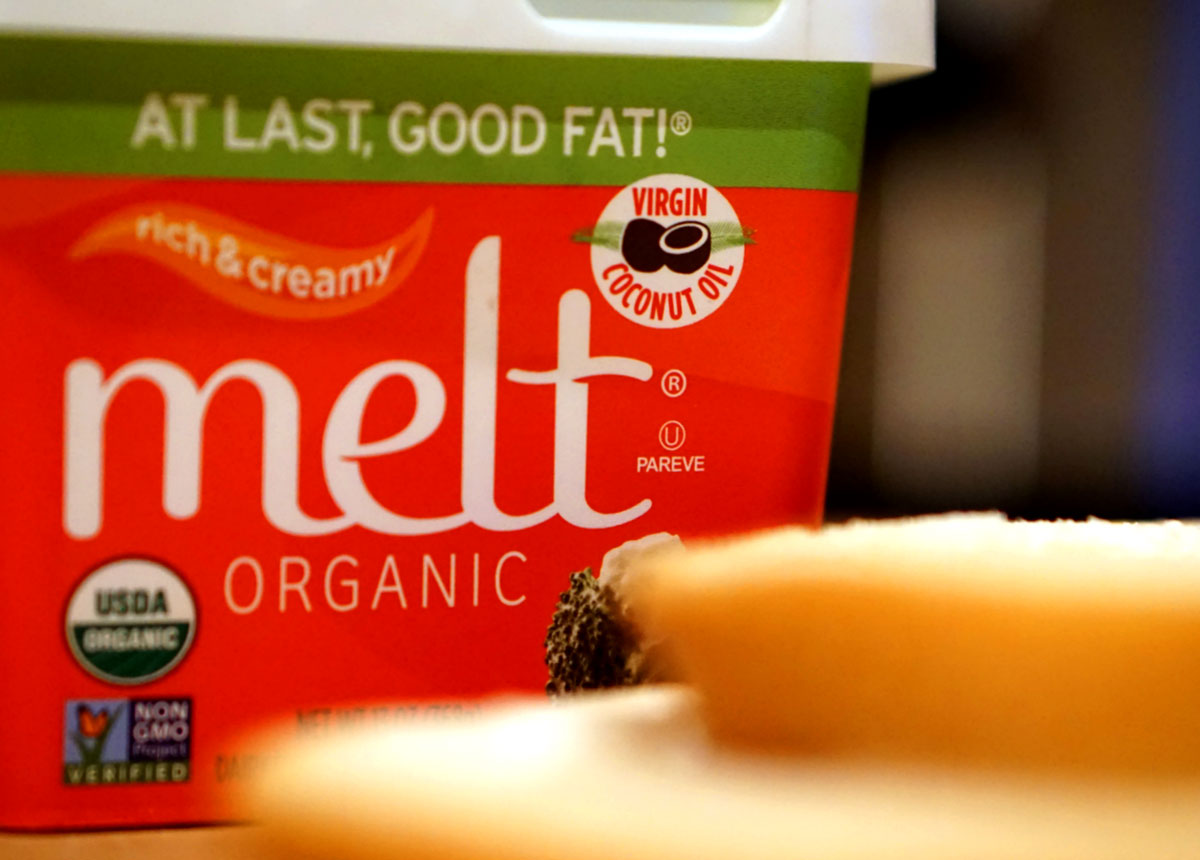
But Melt has not only survived, it has thrived, expanding both its geographic footprint and product line. Melt products, which now include honey- and chocolate-flavored spreads, can be found in more than 7,000 stores of retailers from Bellingham, Washington, to Key West, Florida, and across the border in Canada.
In addition, the 10-person team will soon launch two new products: Melt Organic Buttery Sticks optimized for baking and cooking and Probiotic Melt Organic Buttery spread, which delivers active cultures more effectively than yogurt.
Still, in the hyper-competitive consumer packaged goods industry and particularly in the dairy and dairy substitute aisle, the company says it must rely on its ability to outsmart, not outspend, its competition, no matter the challenges that arise.
“When you don’t have the built-in advantages of the big guys,” Melt founder Cygnia says, ”You have to get pretty powerful at turning your obstacles into opportunities.”