

Technologist Michael Wilson partners with local agency Drake Cooper to create video games and a business.
It’s probably fair to say that Michael Wilson’s career path is just a bit different than most Boise technologists.He’s founded a boutique gaming company that sold millions of games. Then served as Chief Technology officer for a couple of huge — if not legendary — ad agencies: Grey New York and Bridge Worldwide (now Possible Worldwide). And then launched a cutting-edge rating and recommendation engine for mobile games that went head-to-head with Apple’s own tools.
His next move?
Boise, Idaho.
“My wife had accepted a job as a account manager with a Fortune 500 company and at first travelled back and forth from our home in New York,” Wilson explains. “I was working on startups and doing some consulting in New York but had this idea that I could do development from here in Boise.”
As he started house-hunting in Boise, Wilson realized that he and the CEO of Boise advertising agency Drake Cooper, Jamie Cooper, had a mutual friend in the agency business. They met for coffee and fell into a conversation about the future.
“Jamie is like the nicest guy in the world,” says Wilson. “He said he had some extra office space and would just like to have me around.”
So Wilson made the move, taking a part-time role as Chief Inventor for Drake Cooper and tinkering on some game projects. By spring of 2014, Cooper and Wilson decided to make their relationship more official by creating Ponywolf, a joint venture that would produce dynamic, story-driven games for both clients and independent distribution.
The company has already received a great response for a game it developed for Boise-based Kount last year. In addition, Ponywolf is pushing forward on projects for a national game publisher as well as titles they plan to release and market themselves.
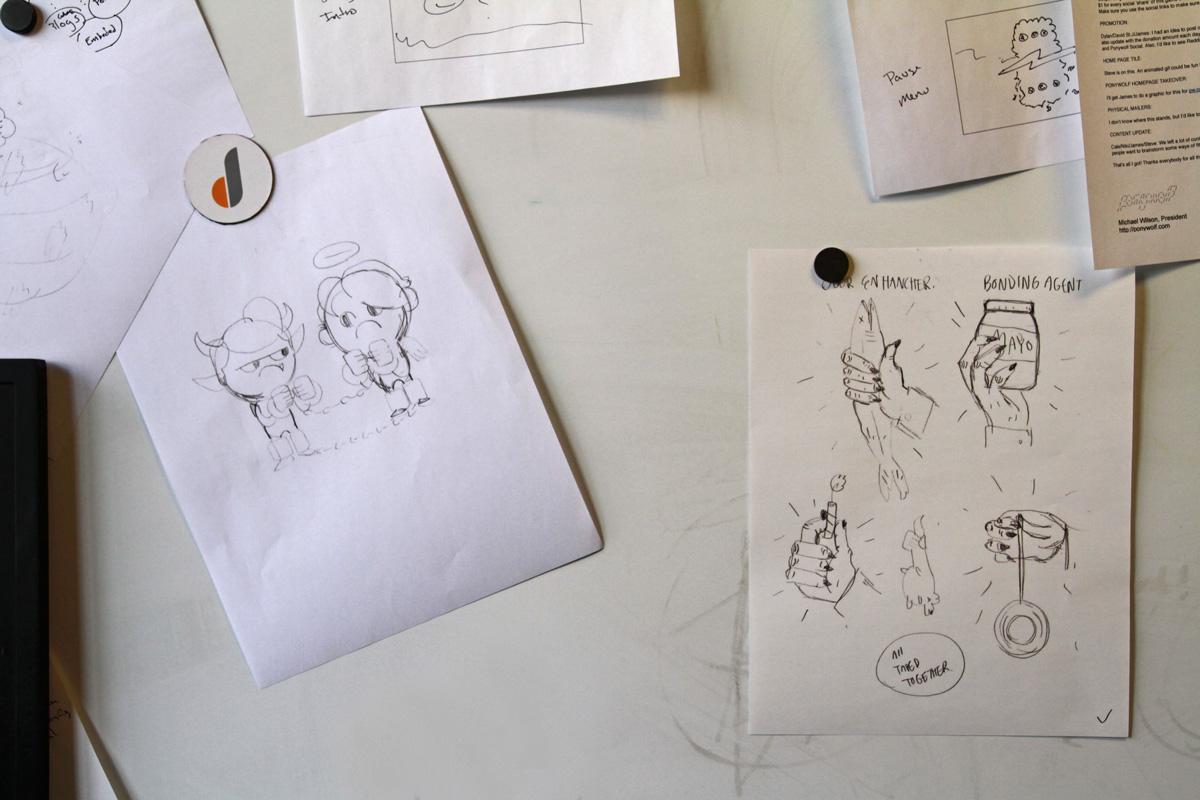



“Everybody wants to do game development, no matter what the industry,” Wilson says.
“We like to find what’s core to a company’s mission — what’s the non-intrinsic value of the brand that makes it fun — then we can turn that into a game.”
It’s something Wilson has done many times before for brands ranging from Chef Boyardee to Pampers. For fraud detection company Kount, Wilson and his team created a game that not only is engaging to play, but also provides a behind-the-scenes look at how criminals prey on online business. The game, called Fraud Tycoon, is available as a free download in Apple’s App Store and Google Play. Kount also uses it as a giveaway at industry trade shows.
“I certainly believe brands need to make games,” Wilson says. “For what they spend on digital, it makes very little sense for them not to have a presence on the phone.”
The seed for Wilson’s passion for the game industry was planted a long time ago in his childhood home of Kentucky. Raised on the Atari 2600 game console playing Pac-Man and PitFall!, he was already bitten by the gaming bug. But it wasn’t until he secured an internship at a software company in college that he really saw the opportunity.
The company, which created bulletin board software (BBS), was acquired several times, Wilson says. “Every time I’d go back for my summer internship, I’d get a newer desk and a better job.”
Eventually, IBM bought the company, which meant Wilson now worked for the computing giant. “I got an access card with an IP address. I thought that was so cool,” Wilson reminisces. “The developers there were really smart, doing really cool stuff. Interesting internet pioneery kind of stuff."
He was hooked on software engineering. Then his former college roommate called with an interesting offer.
“Microsoft was sponsoring a game contest, and he thought we should enter,” Wilson says. "He would do the 3D animation, I would do the coding.”
The pair lost the contest, but landed a contract from a major publisher. And Wilson’s first video game company was born.
Today, while Wilson leads the charge on all of the company’s game development, Drake Cooper creatives and contract employees regularly chip in on the efforts.
“It’s amazing to have an agency to support you,” Wilson says.
“Startup life can be so insular, it is nice to have a bunch of people to bounce ideas off. And it’s really great to reach out and grab the resources you need. Illustrators, programmers, project managers. It’s a really great group of people here.”
Ponywolf is coming to life at a tumultuous time for the gaming industry. An explosion of free online and app-based games means it’s getting tougher for consumers to discover some smaller titles. Even the promotion free games, quite paradoxically, requires an investment, according to Wilson. “You even have to advertise ‘free’,” he says.
Still, a hit video game can translate into millions of downloads and plenty of cash, not necessarily from selling the game, but from in-app purchases such as accessories and extra lives. For smart developers, it means the monetization strategy is integral to the game design from the very beginning of the process.
“There’s a real hunger for interesting things, but there’s also a real hunger for monetization strategy,” Wilson explains. “For a business, it doesn’t matter how fun it is if you can’t make money.”
Note: See Ponywolf's latest games at ponywolf.com.
Photography by Chris Ennis